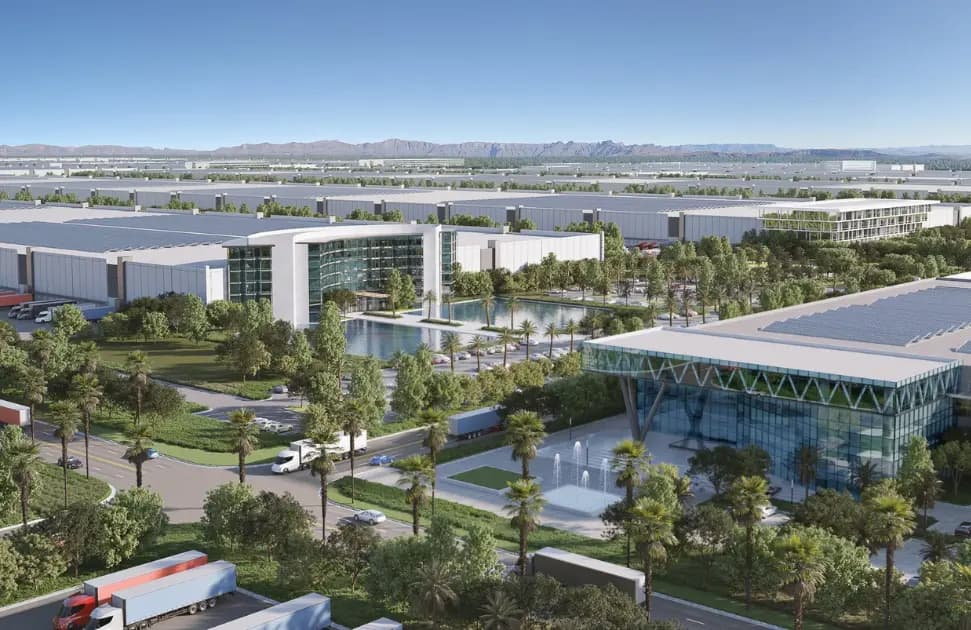

A broader shift in commercial property strategy
Commercial real estate has historically evolved alongside infrastructure. Rail access once determined the value of industrial sites. Later, highway proximity became a defining advantage for logistics facilities, while fiber connectivity reshaped office and data center development.
Modern energy infrastructure, including capabilities such as solar power integration, battery storage, EV charging, and support for increased electrification, is now beginning to play a similarly critical role in commercial property performance. As electrification accelerates and electricity pricing becomes highly volatile, buildings that can support these evolving energy demands are set to gain a stronger competitive position. Those that cannot may face rising retrofit costs, operational challenges, and a narrower pool of prospective tenants. JLL's 2026 outlook identifies energy capability as an emerging differentiator in how competitive a property is, while broader U.S. demand projections from the EIA underscore why these considerations are moving from niche investments into mainstream commercial real estate planning.
Practically, modern energy capabilities are becoming as important to asset competitiveness as accessibility, parking, and digital connectivity. Features such as on-site energy generation, energy storage, EV charging infrastructure, and support for electrified operations are increasingly influencing long-term property performance and market appeal. Owners who recognize this shift early will be better positioned to sustain leasing demand and protect asset value over time.
How do we avoid becoming the site that cannot support what comes next?
For decades, location and transportation access were the primary measures of whether a commercial property would remain competitive over time. Those factors still matter, but two additional considerations are rapidly becoming just as important: energy capacity and cost stability.
Tenants and operators are asking far more detailed questions about power infrastructure than they were five years ago. Manufacturing facilities are placing greater demands on electrical infrastructure, while warehouses are relying more on automation and robotics. At the same time, data-intensive logistics systems are driving significantly higher electricity loads, turning energy pricing and grid reliability into real operational concerns.
The broader demand outlook reinforces the scale of the shift. The U.S. Energy Information Administration projects that U.S. electricity consumption will increase by 1% in 2026 and 3% in 2027, marking the first four-year period of sustained demand growth since 2007 and the strongest four-year growth cycle since 2000.
For commercial property owners and developers, the challenge is no longer simply whether additional power can be added when needed. The more important question is whether an asset can remain competitive over the next decade as tenant requirements evolve. If a property cannot clearly support a tenant's operational power needs, the issue stops being purely technical and begins affecting the transaction itself. Owners lose negotiating leverage, and properties become more difficult to lease, particularly in highly competitive markets such as New York City and Los Angeles.
Reports from both markets already indicate that energy resilience is influencing site selection decisions and contributing to rent premiums. As a result, more owners are beginning to view energy infrastructure in the same way they view structural upgrades, loading capacity, or parking availability: as a factor that directly shapes leasing performance and long-term asset value.
Why energy capacity is becoming a leasing factor
Historically, most commercial tenants assumed sufficient power would be available when needed. If operations expanded, utilities would upgrade service capacity, and the associated costs were generally manageable. That assumption is becoming increasingly difficult to rely upon.
Across the United States, grid infrastructure is facing growing strain as more equipment, facilities, and transportation systems shift toward electrification. The EIA's latest outlook points to continued increases in electricity consumption through 2027, driven in part by large-scale data centers and the broader transition away from fuel-powered systems.
At the same time, interconnection timelines are lengthening significantly. Research from Lawrence Berkeley National Laboratory found that projects completed in 2023 took nearly five years on average to move from interconnection request to commercial operation — up from approximately three years in 2015 and less than two years in 2008.
The implication is significant: a building may be physically ready for occupancy yet still fail to meet tenant requirements because neither the property nor the surrounding grid infrastructure can reliably support the necessary electrical load.
When that occurs, leasing becomes more difficult, upgrade timelines compress, and project costs rise under operational pressure. It also fundamentally changes the leasing conversation. If an owner cannot answer questions about power availability, reliability, and scalability with confidence, tenants are unlikely to wait through uncertainty. In competitive markets, they will move toward sites with clearer infrastructure readiness and fewer operational risks.
The hidden cost of waiting until a tenant asks
Despite rising energy costs and growing infrastructure risks, many energy upgrades are still handled reactively. Sometimes that approach works. More often, it does not.
When utilities are facing infrastructure constraints or equipment shortages, project timelines can extend far beyond what tenants are willing to accept. By the time a tenant requests additional power, the window to plan strategically may already be closed.
As of the end of 2024, roughly 10,300 active projects in the U.S. were seeking grid interconnection, representing about 1,400 GW of generation capacity and 890 GW of storage capacity. In that environment, waiting until a tenant asks for more power is already too late.
At that point, the situation is no longer a planned improvement — it becomes a scramble to complete upgrades under pressure. Options become limited, timelines shift out of the owner's control, and what could have been part of a long-term capital strategy turns into an urgent fix tied to occupancy deadlines.
That is why forward-looking owners and developers are evaluating energy capacity much earlier, often during redevelopment planning or broader capital improvement cycles. Planning ahead creates more flexibility and allows teams to design the right solution before the situation becomes urgent.
Solar and storage as asset-level upgrades
Solar and storage as asset-level upgrades is where the financial benefits become easier to quantify, and where energy storage starts to provide value beyond simple backup power.
Solar reduces the amount of electricity a property must purchase from the grid. In one recent example, a solar-plus-storage system reduced peak grid demand from 130 kW to 70 kW, a decline of about 46% under a peak-reduction strategy. This reduction matters because commercial electricity costs in 2026 are driven not only by total energy consumption, but also by demand spikes during peak periods.
The savings extend beyond demand reduction. In a 2024 California Energy Commission case study, a battery used for peak shaving reduced annual demand-charge costs by approximately 23%, saving around $4,300 per year. The same study found that charging the battery with on-site solar generated an additional $4,780 to $6,000 in annual utility savings.
Similar results have appeared outside California. A 2024 evaluation by NYSERDA found that most participating sites saved up to $5,000 annually on demand charges, while one site saved more than $25,000 per year.
Utility pricing structures further strengthen the case for storage. Under one SDG&E commercial rate schedule in 2025, summer on-peak generation charges reached $0.37652 per kWh, compared with just $0.07879 during super off-peak hours.
That pricing gap highlights the value of storage at the property level. It allows sites to store lower-cost energy and use it later when grid electricity is significantly more expensive.
Taken together, these strategies give properties greater operational flexibility. They can reduce cost pressure, support future growth, and help avoid rushed utility upgrades before lease renewals or tenant expansion needs arise.
The impact on property competitiveness
From a leasing perspective, energy upgrades are no longer a "nice-to-have" feature.
According to NAR's 2025 commercial sustainability report, 32% of respondents said utility and operating costs were a major factor in leasing and purchasing decisions. CBRE found similar results: 43% said sustainable building features influence rent negotiations, while 40% said the same about EV charging infrastructure.
Properties with a clear, reliable power strategy are becoming easier to market than those that may require rushed upgrades later. JLL reported in 2025 that power availability is increasingly driving commercial real estate value, with some tenants willing to pay rent premiums of up to 49% for dependable energy infrastructure.
At that point, energy is no longer just an operational issue — it becomes part of the leasing conversation itself. And once that happens, the question shifts from whether upgrades matter to when they should be planned.
Why owners are evaluating upgrades earlier
Electrical equipment lead times continue to expand across the industry. In 2024, the U.S. Department of Energy reported that lead times for large power transformers had stretched significantly, with 36-month waits becoming common and some projects facing delays of up to 60 months.
As a result, energy decisions made late in a project can create scheduling problems that affect the entire development timeline.
Owners who assess energy capacity earlier gain far more flexibility. They can align upgrades with planned capital improvements, integrate solar infrastructure into roof and parking design, and coordinate utility work with longer planning horizons.
More importantly, early planning keeps owners in control. Upgrades can be phased strategically, budgeted properly, and aligned with long-term asset goals instead of becoming reactive expenses driven by urgency.
Where SolarMax fits in
SolarMax Technology works with commercial property owners, facilities teams, and real estate operators to evaluate how on-site solar and storage can improve operational performance.
From utility bill analysis and system design to permitting, financing, installation, and ongoing support, we help clients reduce operating costs and manage energy demand more effectively.
That process is most valuable when it starts early. Early evaluation gives property teams more time to assess constraints, plan upgrades strategically, and build solutions that match the site's long-term operational needs.
For owners looking to keep properties competitive in a changing energy landscape, one question is becoming harder to ignore: does this site have the energy infrastructure to support what comes next?